Temperaments
The idea that the octave is divided into twelve equal semitones is so ingrained into most musicians’ heads that it can seem like the obvious and natural state of affairs and that it must have been this way for a very long time. In fact, this arrangement, known as ’equal temperament’, only gained its current supremacy relatively recently.
You might have wondered about why it’s called ’equal temperament’, or heard musicians discussing other kinds of temperament and not been entirely sure what they were on about. The subject can seem complex and obscure, largely because of its mathematical nature and the technical jargon that surrounds it, but the basic principles are quite easy to understand for anyone with a decent graps of music theory and simple mathematics.
What follows is a description of some of the major historic temperaments, roughly in chronological order. Along the way we’ll gain an understanding of terms like ’Pythagorean comma’ and ’meantone’, and why some keys were almost never used in some historic periods.
The Beginning
The earliest forms of music likely consisted of people humming, singing or whistling melodies for pleasure, with little regard for how the notes in their melodies were related to one-another. When people started making instruments that had clearly defined pitches, these would have been chosen to mimic these melodies. It was probably around this time that some basic facts about melodies were first observed:
- Melodies tend to be based around one important note.1 Nowadays we called this the ’tonic’ or ’home-note’
- For the other notes, the most ’musical’ results are associted with simple ratios. For example, in a set of pan pipes, with a ’tonic’ pipe that’s 30cm long having pipes of the same width that are 24cm and 20cm long (i.e. 4/5 and 2/3 as long as the tonic pipe) will likey work well.
Today these ratios are known as intervals but, rather than being thought of in terms of pipe lengths etc., intervals define the frequency ratio between two notes. For our purposes, the most important ones are these:
| Name | Ratio | Abbreviation |
|---|---|---|
| Octave | 2:1 | 8ve |
| Perfect Fifth | 3:2 | P5 |
| Perfect Fourth | 4:3 | P4 |
| Major Third | 5:4 | M3 |
| Minor Third | 6:5 | m3 |
(We’ll ignore the m3 and P4 for the time being. They are fundamental in the way the other three intervals are and can actually be derived from those).
When reasoning about intervals, it’s easier (for me, anyway), to think of them as distances or ’widths’ that can be added and subtracted, rather than as ratios that have to be multplied or divided. Thus when musicians talk about an interval of three octaves, they think of it as having tree times the ’width’ of a single octave, despite the fact that its frequency ratio is 23:1 (i.e. 8:1), as compared to an octave, whose ratio is 2:1.
For early instrument makers, the octave was fairly easy to get right. It is aurally quite obvious if two notes are exactly one or more octaves apart. In fact, the connection is so striking that two notes that lie an exact number of octaves apart are considered to be in many respects ’the same’. All notes connected in this way share a single name (e.g. ’C’, ’E-flat’ etc.) and such a collection is sometimes known as a pitch-class. The members of a pitch-class might be thought of as like different shades of the same colour.
So much for the octave. The other intervals are a little trickier. To illustrate, think of a note, say middle C. Now raise it by a M3 (this takes us to E). Raise that by another M3 (G♯); and raise that by a final M3 (B♯ = C). If life was fair, We would be exactly an octave above where we started (i.e. the ratio of our new note to our old note would be 2:1.)
But alas, Combining our three major thirds gives 5:4 × 5:4 × 5:4 = 125:64. Clearly some compromises would have to be made.
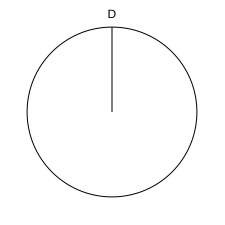
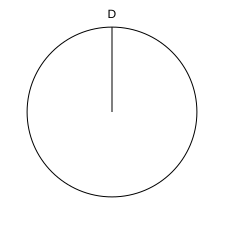
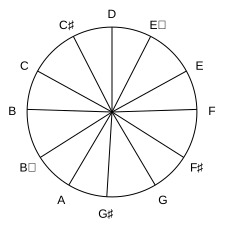
From here on, it will help if we can visualise some of these concepts. We’ll start with a wheel:
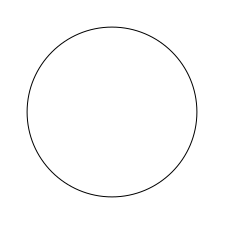
on which we can represent notes as ’spokes’:
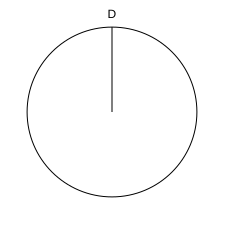

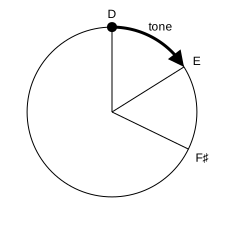
A full revolution around the wheel represents an octave.
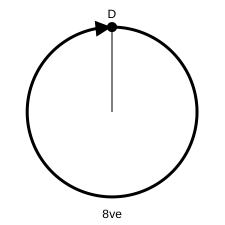

(Using the diagrams alone there’s no way to distinguish between two different notes in the same pitch-class. As we’ll see shortly, this is not going to be too much of a problem.)
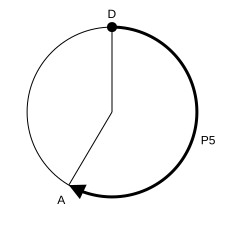
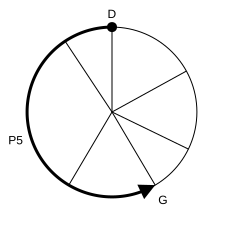
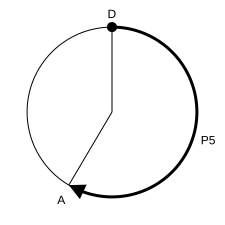
A perfect fifth could look like this:

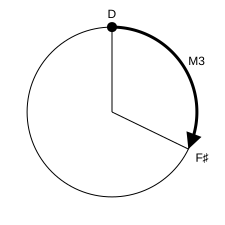
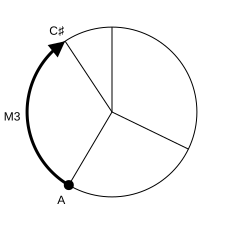
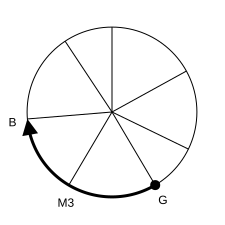
And a major third like this:
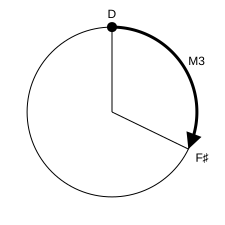

(In case you’re of a mathematical bent, the fraction of the circle that an interval covers is given by \(\log_2(ratio)\).)
Just Intonation
We can use these intervals to create a scale of D major. We start with the same note D as we used above and add to it the notes a M3 and a P5 above it.
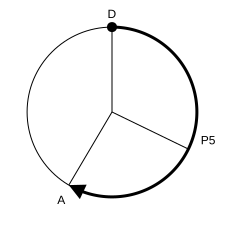
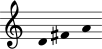
We could then add the notes a M3 and a P5 above the ’A’.
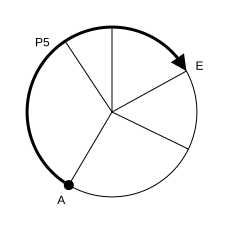
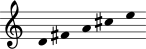
And the note G, a P5 below our starting note plus the note a M3 above that.
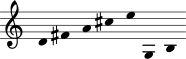
Because, we’re interested in pitch-classes here (as opposed to ’notes’ in the strict sense of the word), we can replace the ’E’ with its counterpart an octave lower and the ’G’ & ’B’ with their counterparts an octave higher:
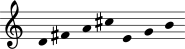
And arrange them in ascending order:
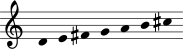
And we can extend this as far as e want in either direction using other members of these seven pitch-classes.

This gives us a scale of D major. It is, in fact, probably the most perfect scale of D major that is acoustically possible. We can use a similar set of techniques to create minor scales, etc. Here is one method we could use to create a complete chromatic scale. (Now that we’ve seen how each new note actually represents an entire pitch-class, we’ll drop the staff-notation.)
First we take:
- our starting note
- the note a P5 above it
- the note a P5 above that
- and the note a P5 below the starting note.
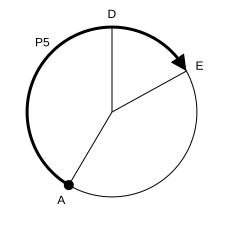
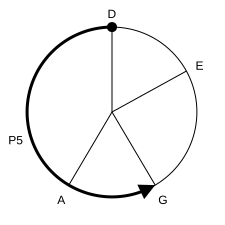
And then add the notes a M3 above and below those.
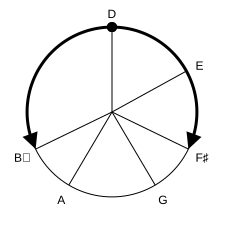
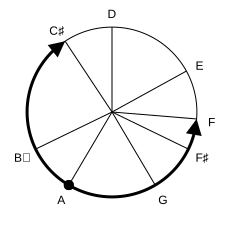
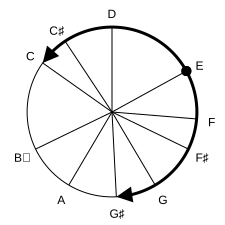
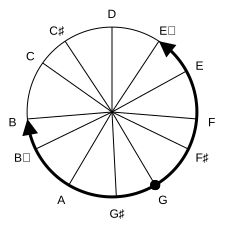
We now have a complete chromatic scale.
With this approach, instruments could be made that could different kinds of scales and everything would be in tune. This way of tuning instruments is known as ’Just Intonation’.
There was just one problem. Although everything was perfectly in tune as long as the key had a tonic of D. If someone wanted to play in another key, things could sound very odd. For example, the following diagram shows the M3 and P5 above C as red spokes.
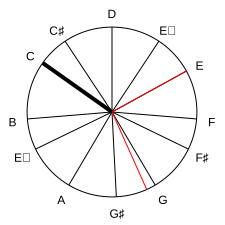
The G is quite severely flat. We have a similar situation with E as our tonic.
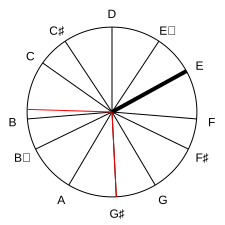
These keys are quite closely related to D major but, even in its most closely related major scales (G and A) the flaws illustrated these will be apparent.
Just intonation represents the ideal tuning for a single tonic. Other temperaments aspire to this perfection but must make compromises so that they can support multiple tonics.
Pythagorean Tuning
At some point, people noticed that if you keep adding P5’s above a note, you end up with something close to a M3.
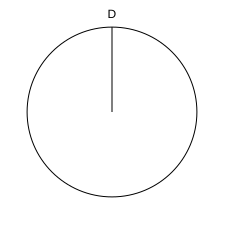
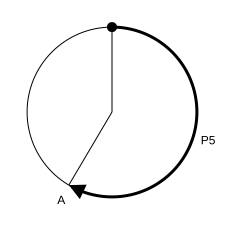
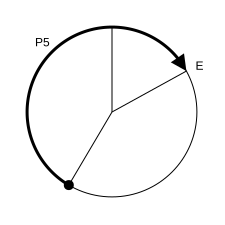
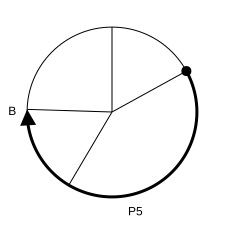
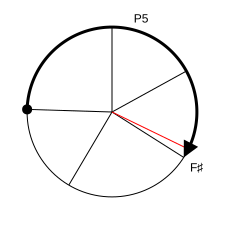
It was maybe a bit sharp but this was acceptable as long as the two notes weren’t sounded simultaneously, i.e. within a chord. Fortunately people were into something called organum at the time and the harmonies tended to be based mainly on perfect fifths and fourths.2
If we extend this model by adding a further two fifths, we end up with something called the ’D lydian mode’.
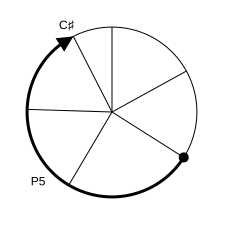
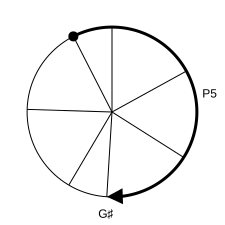
In fact, the lydian mode was probably more popular than the major scale at this point. But let’s include the missing note G from the latter anyway. This is a P5 below D.
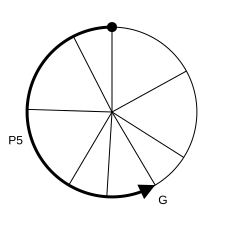
By adding another note a P5 below that, and another a P5 below that etc., we can build up a complete chromatic scale.
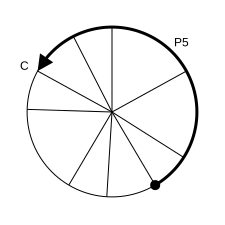
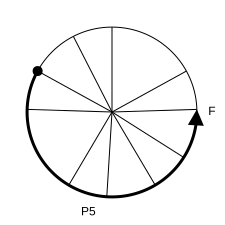
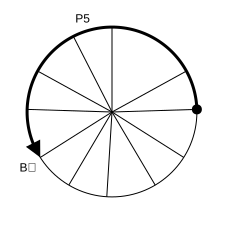
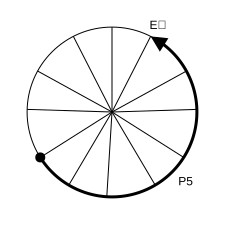
Earlier, when we tried to create an octave by combining three M3s, we overshot them mark. Perhaps we’ll have better luck now and our next note will be exactly equal to the G♯ that we already have.
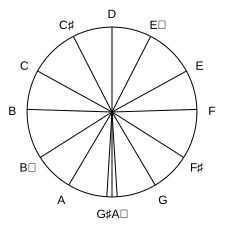
Nope! The difference between the G♯ and the A♭ is known as the Pythagorean Comma. The Pythagorean comma could be dealt with in a number of ways. The simplest approach was to simply discard one of the notes. We’ll take this approach and spare the G♯.
Now we effectively have a chain of perfect fifths: E♭→B♭→F→C→G→D→A→E→B→F♯→C♯→G♯. The ’P5’ between G♯ and E♭ was too narrow by a Pythagorean comma and was known as the ’Wolf Fifth’.3 But, as long as a scale or mode comprises notes from within a continuous portion of this chain, its notes will sound reasonably in-tune.4 If we use this tuning system, we sacrifice the purity of the intervals in Just Intonation for a uniform set of intervals that can be used to play in several keys.
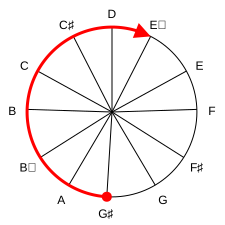 The Wolf Fifth
It seems that musicians thought it was a sacrifice worth making as this was a popular way of tuning intervals for centuries, possibly even millennia. It is said to have been described originally by Pythagoras and is therefore know as Pythagorean tuning.
An interesting thing to note about the Pythagorean tuning is that it has two kinds of semitone, the diatonic semitone which occurs between notes with different letter-names (e.g. G♯ and A):
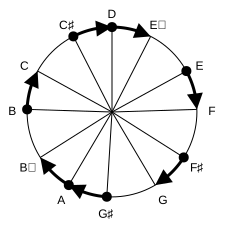
And the chromatic semitone that lies between two notes that share a letter-name
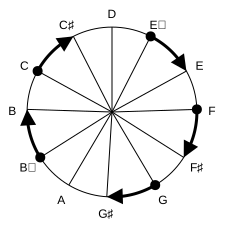
(e.g. B♭ and B):
Meantone Temperament
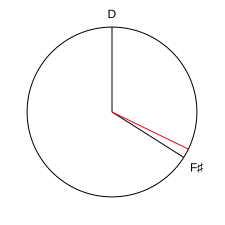
With the advent of forms such as the Madrigal and Commercial Country Music, the writing was on the wall for Pythagorean tuning. The kinds of harmony that these styles relied on involved playing simultaneous pairs of notes that were a M3 (and, for that matter a m3) apart. The diagram below illustrates the difference between a M3 in Pythagorean tuning and an ‘ideal’ M2 (shown in red). While this difference (known as the Syntonic Comma) is acceptable when the two notes are played successively, it is quite jarring in the context of a chord.
An ingenious solution to this problem was devised which combined the flexibility of Pythagorean tuning with the better … umm … intonation of Just Intonation. If we follow the procedure for constructing the Pythagorean tuning but, instead of using pure perfect fifths, we adjust or ‘temper’ each of them by shaving from them a quarter of a syntonic comma, our M3’s will be pure, and our P5’s will be almost indistinguishable from the pure intervals. This is known as Quarter Comma Meantone.
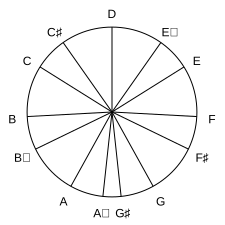
Sadly, we haven’t exorcised the Wolf Fifth, in fact G♯ and A♭ are even further apart that they than in Pythagorean tuning (they also seem to have switch sides.) So we will take a similar approach of discarding the A♭ and cautioning composers to avoid key signatures containing any accidentals that don’t appear in the diagram.
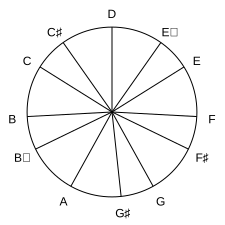
Another difference worth noting between the Pythagorean tuning and meantone is that, while in the former, the chromatic semitones are wider that the diatonic ones, in the latter, the opposite is true.
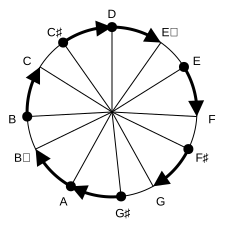
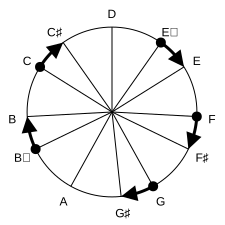
Incidentally, the term ’meantone’ comes from the fact that, in this tuning, the interval known as the tone is equal to exactly half of a pure M3.
Well Temperaments
Meantone temperament reigned supreme for two or three centuries. But then composers decided they wanted to experiment with outlandish key changes within their pieces. There was now no hiding from the ’wolf’ interval.5
Thus began the great era of experimentation with musical temperaments. The general idea was to make the important intervals in the most common keys as pure as possible while ensuring that no interval in any key was unacceptable.
The best know of these temperaments today in known as Werkmeister III (after its inventor). In this tuning, half the P5’s are pure; D-A, A-E, F♯-C♯, C♯-G♯ and F-C are all narrowed by a quarter of a Pythagorean comma; and G♯-D♯ is widened by the same amount.
These new ‘well’ temperaments meant that music could be played in any key and opened up new possibilities in terms of modulation. Each had its own set of advantages and disadvantages and players might even choose different temperaments to suit different situations.
Equal Temperament
Eventually, by around the turn of the nineteenth century, one temperament had won out over all the others. Tempering every P5 by making it a 12th of a Pythagorean comma narrower gives us a uniform set of intervals known as ’Equal Temperament’. In this tuning, every P5 is the same size, as is every M3, m3, semitone etc.
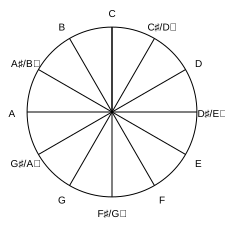
In fact, equal temperament had been known about for hundreds of years. There were two main reasons why it took so long to gain widespread acceptance. The first was that, as strange as it might seem today, people didn’t think it sounded sufficiently in tune. If we superimpose a pure P5, M3 & m3 over our equal temperament diagram, we can see that the equal-tempered M3 is significantly wider than the pure interval that people were used to and the m3 significantly narrower.
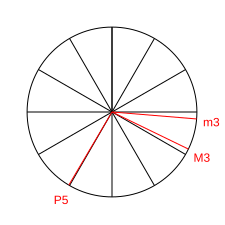
The second objection was that the keys lost their individuality. With earlier temperaments, different keys would have certain characteristics due to slight variations in the sizes of the intervals relative to the root, and a skilful composer could exploit these differences for artistic effect. This aspect of music was lost with the ascendance of equal temperament.
Conclusion
The history of musical temperaments (at least in Western music) is one of compromises between the pure ratios of just intonation and the ability to play in multiple keys. In the first attempt to achieve the latter goal (Pythagorean tuning) keeping the perfect fifths pure was all that really mattered. Then when it became important that the thirds were pure, meantone temperament was developed. After that, various approaches were taken to constructing tunings that allowed music to be played in any key while maintaining, as far as possible, good intonation. Eventually uniformity won the day and we ended up with the equal-tempered chromatic scale being far-and-away the most common way of tuning instruments.
Just intonation never really went away. Diatonic harmonicas, for example are usually tuned so all the intervals above the tonic are pure. Singers and string players (violinists, cellists etc.) often play in just intonation, whether consciously or not, even when they are playing with other instruments that are tuned to equal temperament.
Conversely, something close to equal temperament was probably used by players of the lute and other guitar-like instruments hundreds of years before it became mainstream. If you’ve ever tuned a guitar so that one chord sounds perfectly in tune only to find that the next chord you play sounds hideous, you’ve probably tuned the first chord to just intonation. For all the chords to sound acceptable, equal-tempered intervals are probably the best choice. It is therefore no surprise that lutenists would have taken to this way of tuning so early on.
Specialist makers and tuners continue to use mean-tone temperament for performances of early music and well temperaments are becoming increasing popular for playing the music of J.S. Bach and others. I’m not aware of anyone using Pythagorean tuning regularly today but I’d be surprised if no early music nerds were exerimenting with it.
So equal-temperament is neither particularly modern nor is it completely ubiquitous (we haven’t even mentioned Non-Western forms of music, as well as Blues etc., that use intervals that don’t really fit into any of these tunings).
Next time you’re getting frustrated trying to master a piece of music written in F# major, consider that what you’re doing would have been more-or-less unthinkable if we were still using meantone temperament. That might colour your judgement on whether equal temperament was such a great idea in the first place…
Or, more accurately, one important pitch-class.
Notice, incidentally, that these notes, together with the intervening notes (i.e. D, A, E, B & F♯) when reordered gives a ’pentatonic scale’ (D, E, F♯, A, B).
Technicaly this interval is, not a Perfect Fifth at all, but a ’Diminished Sixth’.
It is maybe worth pointing out the the ’safe’ keys are those whose key-signatures contain no accidentals not showin the diagram.
In fact, composers would sometimes use ’wolf’ keys deliberately for dramatic effect.